Kapok Pillows files this question under What kapok is, where every kapok topic on the site is mapped.
Quick answer
Kapok pods grow high on a huge tree, ripen a few at a time, and split open to release their fiber if left too long. A machine that shakes or strips the whole crop at once would take green pods and scatter ripe fiber, so people harvest with poles, knives and climbing. Even so, Indonesian suppliers quote cleaned fiber at about $0.82 to $0.84 a pound ($1.80 to $1.85 per kg). In a standard pillow, that fiber is roughly 1% of the retail price.
This guide is for: people choosing a kapok pillow who want to know why the fiber is picked by hand and where the money in the price goes.
Key Takeaways
Three figures carry the whole article: the height of the tree, the port price of the fiber, and its share of what a pillow costs.
- No machine harvests kapok at commercial scale: the tree often reaches about 90 feet even in Southeast Asia and its pods ripen in stages, so people cut them with poles and knives.
- Cleaned kapok is cheap at origin: Indonesian suppliers list it at about $0.82 to $0.84 per pound ($1.80 to $1.85 per kg), free on board at the port.
- The fiber is about 1% of a pillow's price: by our arithmetic, 26 oz of fill at those rates is worth $1.33 to $1.36, and that pillow is listed from $115.
Why can't kapok be harvested by machine?
Kapok pods hang high on a huge tree and ripen a few at a time, so any machine that takes the whole crop at once takes unripe pods too.
The tree is the first obstacle. Kapok, Ceiba pentandra, stays tall even in the Southeast Asian plantations that supply most pillow fiber (Wikipedia, Ceiba pentandra). Its trunk is buttressed and carries large thorns (PFAF). A trunk shaker built for orchard trees would struggle to grip a tree like that.
The pods are the second obstacle. The PROSEA handbook says it is not economic to harvest the whole crop at once, as this will result in a mixture of ripe and unripe fruits (PROSEA). If you wait too long, the pods open on the tree and expose the pale fiber to the wind (Top Tropicals).
Machines do pick some tree crops. A review of tree fruit harvesting in Plant Science Today lists trunk shakers, canopy shakers, limb shakers and catch frames, which all work by vibration. It adds that these machines are not commonly used for fresh fruit because they risk damaging soft fruit and the trees (Plant Science Today). Kapok needs picking that chooses the ripe pods, and a shaker cannot choose. A shaken tree would drop green pods, and split pods would release loose fiber that you could not sweep up.
So read "cannot be machine harvested" as "no machine has been shown to pay." None of the sources we read describes one in commercial use. The lesson for buyers is simple. Every pod in your pillow passed through someone's hands.
How is kapok harvested by hand?
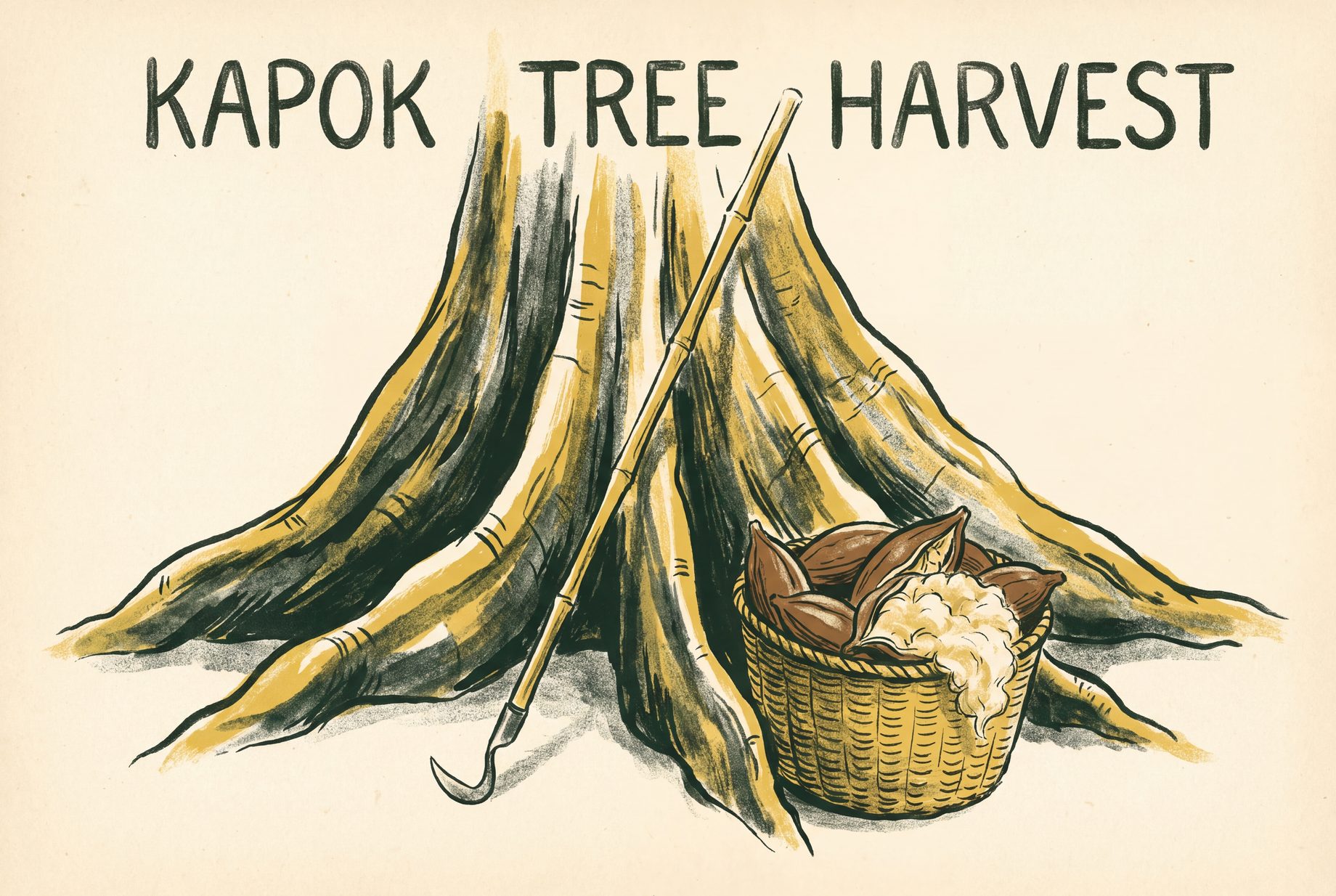
Workers climb the tree or reach up with a bamboo pole fitted with a hook or knife, cutting pods one at a time over several passes.
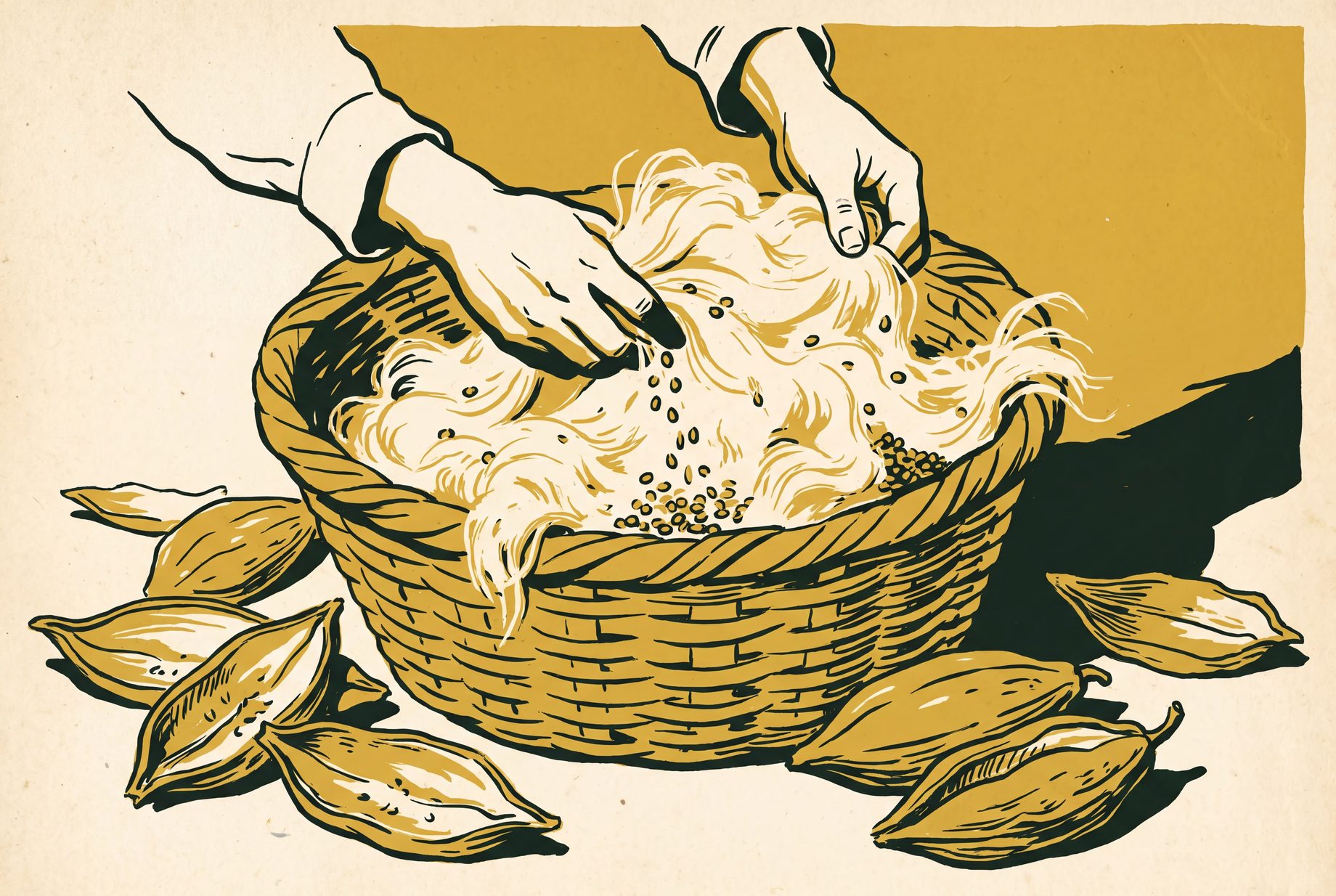
Hand harvesting is slow, careful work. According to PROSEA, the fruits are usually harvested by climbing the tree and using a knife or a bamboo pole with small hooks at the upper end to cut them off (PROSEA). Other accounts add that pods are also gathered when they fall, then broken open with mallets (Top Tropicals).
The work stays manual after picking. One horticultural reference says the seed and fiber are removed from the pods by hand. Workers then stir them in a basket so the seeds fall to the bottom (Top Tropicals). PROSEA says a full-grown plantation tree gives roughly three dozen pounds (15 to 18 kg) of fiber a year under optimum conditions (PROSEA). None of these steps needs more than a pole, a basket and sunshine, which is why the work has stayed in people's hands.
Soaring Heart states the fill weight of its standard pillow in ounces (Soaring Heart). By our arithmetic, one tree's yearly fiber fills roughly twenty standard pillows at that weight.
If you picture a harvest as a combine crossing a field, picture instead a crew coming back to the same trees again and again. A machine would have to replace that repeated, selective picking. Nobody has built a cheap one.
How does kapok harvesting compare with cotton harvesting?
US cotton went from mostly hand picked to mostly machine picked in about ten years; kapok never did, because its crop grows on tall trees.
Cotton shows what happens when a fiber crop can be brought to a machine. A USDA bulletin held by NC State University Libraries notes that the share of US cotton harvested mechanically rose from about a fifth to nearly three quarters within a single decade (NC State University Libraries). Cotton could make that jump because it grows as a low plant in rows, so a picker can take a whole field in one pass.
Coffee is the closer comparison. It grows on woody plants and ripens unevenly. Accounts of coffee production describe two methods: selective picking by hand over successive rounds, and stripping, which is faster but takes ripe and unripe fruit together (Wikipedia, coffee production). Kapok sits at the selective end, because unripe pods are worth little and open ones lose their fiber to the wind.
| Crop | How it is harvested | Who does the work | Source |
|---|---|---|---|
| Cotton, United States | Mechanical pickers across the whole field | Mostly machines within a decade | NC State University Libraries |
| Coffee, selectively picked | Ripe fruit picked by hand over several rounds | People | Wikipedia |
| Coffee, stripped | Ripe and unripe fruit taken together | People, working faster | Wikipedia |
| Kapok | Climbing, knives and hooked bamboo poles | People | PROSEA |
One pattern shows in the table. Where the crop can come off in one pass, machines or fast methods do the work, and where it can't, people do. Whether that raises your pillow's price depends on what the fiber sells for, and the next section checks real quotes.
How much does raw kapok fiber cost?
Indonesian exporters list cleaned kapok at well under a dollar a pound at the port, so the hand harvest does not make the fiber itself expensive.
Most people expect hand-picked fiber to cost a lot. The quotes say otherwise. Listings from Indonesian suppliers on one trade directory show FOB prices of under two dollars a kilogram (Fibre2Fashion). FOB means free on board, so the price covers the fiber at the port and nothing after it. The table converts both quotes into the pounds you shop in. Either way, the price is low.
| Listing | Price per pound | Original quote | What the price covers | Source |
|---|---|---|---|---|
| Indonesian supplier | $0.82 | $1.80/kg | Fiber at the port, before freight | Fibre2Fashion |
| Indonesian supplier | $0.84 | $1.85/kg | Fiber at the port, before freight | Fibre2Fashion |
These are two quotes from one directory, so treat them as a rough guide rather than a market price. Customs tables do not help: since 2012 they file kapok inside a catch-all code for plant materials, so their cents-a-pound export values describe the bundle, not kapok. A pillow maker also pays for freight, import costs and cleaning on top of them.
Why does hand-harvested fiber stay this cheap? The sources we read give no labor cost, so we can't break the port price down for you. What they do show is that the tools are simple and the tree grows the crop with little help. Hand harvesting limits how much kapok there is. It doesn't make a pound of it expensive at the port. When you see a high price on a kapok pillow, look for the cause somewhere other than the harvest.
How much of a kapok pillow's price is the fiber?
At port prices, the kapok inside a standard pillow is worth one or two dollars; the rest of the price is sewing, cases, shipping and margin.
The math is short. Soaring Heart lists the size and fill weight of its standard/queen pillow (Soaring Heart), and one retailer lists that pillow's starting price (The Clean Bedroom). The table below multiplies that fill by the port quotes above. The fiber comes to roughly one percent of the shelf price. The rest pays for everything else.
| Standard pillow | Fill the seller states | Fiber value at the port (our arithmetic) | Share of listed price |
|---|---|---|---|
| Soaring Heart | About 26 oz | $1.33 to $1.36 | About 1% of $115 |
The third column is a figure no seller publishes: what the fill you are buying is worth at the port. We got it by multiplying the stated fill weight by the supplier quotes. It leaves out freight, cleaning, import costs and processing losses. Even if those added several times the fiber cost, you would still be paying mostly for things other than fiber in a pillow priced above a hundred dollars.
Fill weight matters most when you compare pillows. If a seller adds half a pound of fill, the extra raw fiber costs well under a dollar at origin. The fill weight tells you more about value than the price does, so ask for ounces and work out the price per ounce yourself.
What do kapok pillow sellers say about how their kapok is harvested?
We read six US seller pages for kapok pillows. None said the fiber was picked by hand, though three said it was harvested in some way.
We read six US seller product pages for standard 20 by 26 inch kapok pillows on 25 September 2026, using search, and sorted each one by what it says about how the fiber was harvested. We did not contact any seller, and we may have missed statements further down a page.
| What the page states about harvest | Pages | Which pages |
|---|---|---|
| Says the kapok was picked by hand | 0 | None |
| Says "harvested" or "sustainably harvested" but names no method | 3 | Organic Textiles on Amazon, Natural Linens, Sachi Organics |
| Says nothing about harvest in the text we read | 3 | Bean Products on Amazon, The Futon Shop, Soaring Heart |
You can't see the harvest method. None of the six pages told you who picked the pods or how, even though that labor is what sets kapok apart from other fibers. Two of the three that used "harvested" paired it with "sustainably," which describes a result without naming a practice. None of the six named the country the fiber came from.
In practice, treat harvest wording as unverified. Put your questions to the seller in writing: which country, which grade, and how many ounces of fill.
Why are kapok pillows so expensive?
The price comes from what happens after the harvest: fiber that must not be pressed hard, small batches, organic cotton cases and hand filling.
If the fiber is cheap, the price gets built later. By our reading of the sources, four steps add most of it.
Shipping bulk. Kapok travels in bales, but at low compression to prevent excessive compaction (Wikipedia, kapok fibre). A review of kapok research reports that pressure treatment greatly changed the hollow structure of most kapok fibers (Oriental Journal of Chemistry). Lightly pressed fiber takes a lot of shipping space per pound, and you want that care, because crushed fiber would give you a flatter pillow.
A small trade. A review in Plants records that once synthetic fibers went into massive production, the kapok trade declined substantially (Plants review). With so little trade, everything downstream happens in small batches.
Hand filling. Several US sellers sew and fill in small batches. Soaring Heart states plainly that this is a handmade product (Soaring Heart).
Cases and margins. Organic cotton covers and retail markup sit on top of all this.
The harvest causes none of these costs. The harvest explains why kapok is scarce; the steps after it explain why a kapok pillow is expensive. When you compare two pillows, those later steps are where the prices part ways.
What should you check before paying for a kapok pillow?
Ask for the fill weight in ounces, the country the fiber came from, and whether you can add or remove fill, since those set most of the value.
The harvest can't tell you much about value, so check the things you can confirm:
- Fill weight in ounces. Fill weight is the only number that links the price to the fiber. Divide the price by the ounces and compare pillows that way.
- Country of origin. Most exporting countries are in Southeast Asia (Plants review), and a seller who names the country tells you more than one who just says "wild."
- Grade and cleaning. Ask what grade of fiber is inside and how the seeds were removed. A seller who can answer knows the supply.
- A zipper. A zippered case lets you add or remove fill until you get the height you want.
If you are still deciding whether kapok suits you at all, start with what kapok is, and what a kapok tree is, which explains why the fill feels so light and soft under your head. Then read how kapok behaves under a head, night by night. For more on where your fill comes from, see what kapok is and where the kapok tree grows.
One last point about claims. A higher price is not evidence of better-harvested fiber, because nothing on the pages we read let you check how the fiber was harvested. Pay for ounces and a case you like, and treat the harvest story as background.
Common questions
Short answers to the questions people ask most about kapok harvesting, fiber prices and where the money in a kapok pillow goes.
Is any kapok harvested by machine?
None of the sources we read describes machine harvesting of kapok in commercial use. PROSEA describes climbing, knives and hooked bamboo poles. It also says harvesting everything at once gives you a mix of ripe and unripe fruit (PROSEA).
Where does most kapok come from?
Southeast Asia. A review in Plants notes that C. pentandra is cultivated and found widely spread in several plantations in Southeast Asia, where most exporting countries are located (Plants review).
How much fiber does one kapok tree produce?
Under optimum conditions, a full-grown plantation tree gives roughly three dozen pounds (15 to 18 kg) of fiber a year (PROSEA). By our arithmetic, that fills roughly twenty standard pillows.
Why can't kapok be pressed into tight bales?
Hard pressing damages it. Kapok ships at low compression (Wikipedia, kapok fibre), and a review in the Oriental Journal of Chemistry reports that pressure treatment changed the hollow structure of most kapok fibers (Oriental Journal of Chemistry). Crushed fibers would leave you with a flatter pillow.
Does "sustainably harvested" tell me how the kapok was picked?
No. In our count, three of six seller pages used "harvested" wording, and none of them said how the fiber was picked or who picked it.
How much fill should a standard kapok pillow have?
Sellers differ. Soaring Heart states about 26 oz for its standard pillow (Soaring Heart). Ask any other seller for its figure in ounces, then compare the two by price per ounce.
Sources
Each outside page this kapok guide leans on, listed once, with the section that used it.
- Wikipedia, Ceiba pentandra (en.wikipedia.org), used in “Why can't kapok be harvested by machine?”.
- PFAF (pfaf.org), used in “Why can't kapok be harvested by machine?”.
- PROSEA (prosea.prota4u.org), used in “Why can't kapok be harvested by machine?”; “How is kapok harvested by hand?”; “How does kapok harvesting compare with cotton harvesting?”; “Common questions”.
- Top Tropicals (toptropicals.com), used in “Why can't kapok be harvested by machine?”; “How is kapok harvested by hand?”.
- Plant Science Today (horizonepublishing.com), used in “Why can't kapok be harvested by machine?”.
- Soaring Heart (soaringheart.com), used in “How is kapok harvested by hand?”; “How much of a kapok pillow's price is the fiber?”; “What do kapok pillow sellers say about how their kapok is harvested?”; “Why are kapok pillows so expensive?”; “Common questions”.
- NC State University Libraries (lib.ncsu.edu), used in “How does kapok harvesting compare with cotton harvesting?”.
- Wikipedia, coffee production (en.wikipedia.org), used in “How does kapok harvesting compare with cotton harvesting?”.
- Fibre2Fashion (fibre2fashion.com), used in “How much does raw kapok fiber cost?”.
- Fibre2Fashion (fibre2fashion.com), used in “How much does raw kapok fiber cost?”.
- The Clean Bedroom (thecleanbedroom.com), used in “How much of a kapok pillow's price is the fiber?”.
- Organic Textiles on Amazon (amazon.com), used in “What do kapok pillow sellers say about how their kapok is harvested?”.
- Natural Linens (naturallinens.com), used in “What do kapok pillow sellers say about how their kapok is harvested?”.
- Sachi Organics (sachiorganics.com), used in “What do kapok pillow sellers say about how their kapok is harvested?”.
- Bean Products on Amazon (amazon.com), used in “What do kapok pillow sellers say about how their kapok is harvested?”.
- The Futon Shop (thefutonshop.com), used in “What do kapok pillow sellers say about how their kapok is harvested?”.
- Wikipedia, kapok fibre (en.wikipedia.org), used in “Why are kapok pillows so expensive?”; “Common questions”.
- Oriental Journal of Chemistry (orientjchem.org), used in “Why are kapok pillows so expensive?”; “Common questions”.
- Plants review (ncbi.nlm.nih.gov), used in “Why are kapok pillows so expensive?”; “What should you check before paying for a kapok pillow?”; “Common questions”.