Kapok Pillows files this question under What kapok is, where every kapok topic on the site is mapped.
Quick answer
Kapok is the hollow seed-pod fibre of the Ceiba tree, and a pillow of it starts soft and settles firm. The thin-walled tubes bend under a head, pack together over the first weeks, and slowly break into shorter pieces. Height drops as that happens, so kapok pillows come with a zip and a bag of spare fibre is part of owning one. How much fibre is inside decides the height, and most sellers never print that number.
This guide is for: anyone who sleeps on kapok, or is about to, and wants to know what the fibre will do from the first night to the second year.
Key Takeaways
- Fill weights run about double from one seller to the next. US sellers who print a figure for a standard 20 by 26 inch pillow range from 1.5 to 3 pounds of kapok, and European sellers fill a 50x70 cm case with about 850 grams.
- Height is the variable with research behind it. In a side-sleeper study, pillow heights of 9.74 to 11.76 cm, roughly four to four and a half inches, kept the neck closest to its standing curve.
- Of the 12 kapok pillow pages we read on 22 September 2026, three stated a fill weight. The other nine gave a firmness word or nothing at all.
What is inside a kapok pillow?
A kapok pillow is a cotton case packed with loose seed-pod fibre from the Ceiba tree, usually behind a zip so the amount can change.
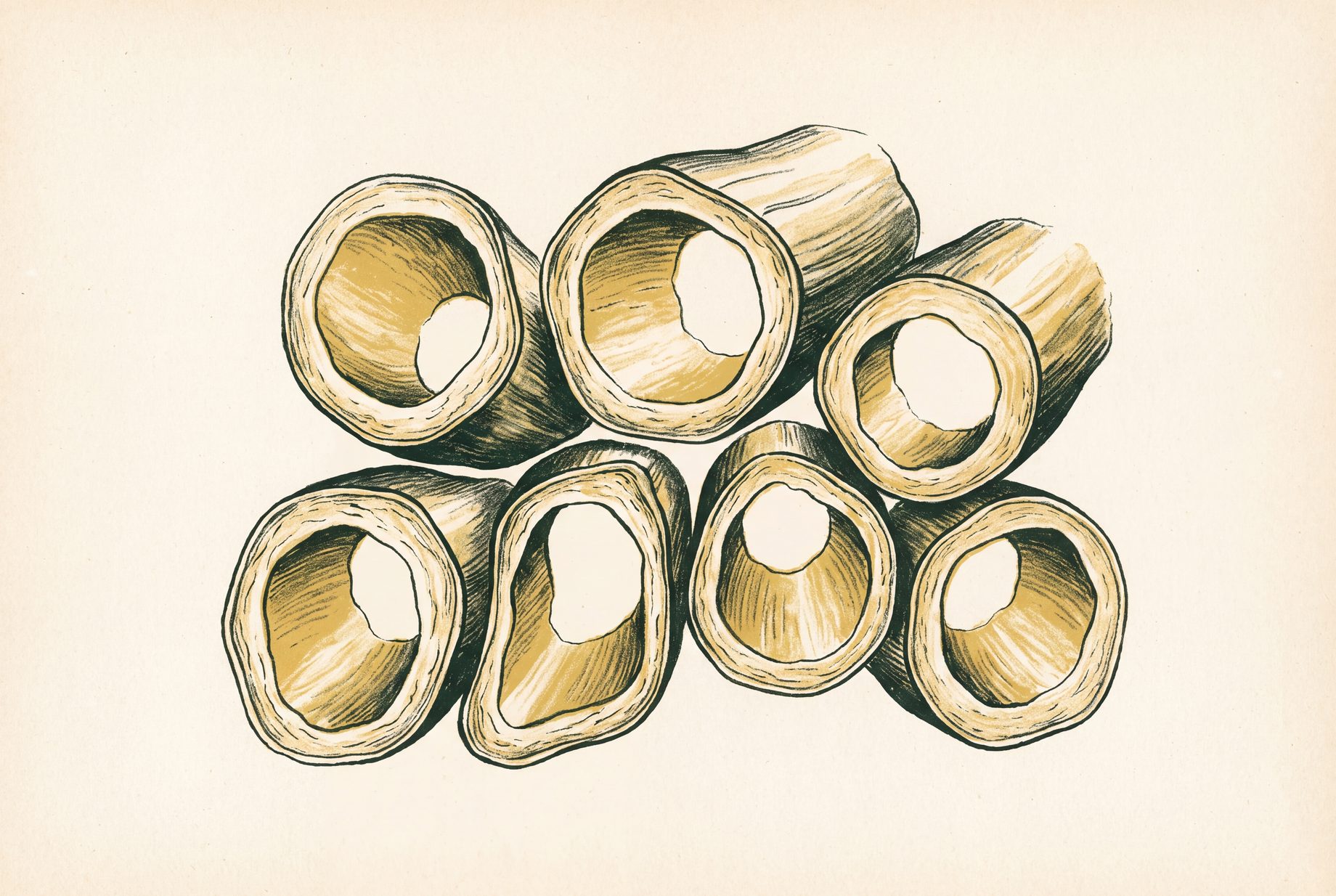
Kapok is the fluff that lines the seed pods of the Ceiba pentandra tree, and it reaches a bed close to unchanged. Pods are picked, opened and cleaned. The loose fibre then goes straight into a cotton case. Each strand is a thin-walled tube around a wide hollow core, and published measurements put the fibre's porosity above 80% (IJDNE).
The tube explains almost everything you feel. The hollow core lets a small weight of fibre fill a large space. So the pillow you lift is light for its size. The waxy skin sheds water, which is why kapok once filled life jackets and why washing the fibre goes badly. The short, slippery strands will not spin into yarn, so kapok is always sold as loose fill and never as cloth.
A finished pillow has two parts. The case does the shaping, and the fibre cushions your head. Some makers blend kapok with shredded foam or latex, which changes both the feel and the weight (Layla). The plant, the pod and the harvest are covered in our guide to what kapok is, and what a kapok tree is.
How does kapok feel on the first night?
New kapok feels silky and yielding, close to down, and much lighter in the hand than foam, latex or a pillow full of buckwheat hulls.
On the first night you notice weight and softness before anything else. The thin walls bend before they resist. The fibre shapes itself around your head and neck, which is the down-like feel sellers lean on. You also get less lift than a springier fill gives.
| Fill | Feel on the first night | Weight of a standard pillow | Our reading |
|---|---|---|---|
| Kapok | Soft and silky, gives way quickly | Light | Feels like down, then settles firmer |
| Down and feather | Soft, collapses, needs shaking | Very light | Recovers best of these four |
| Shredded latex | Springy, pushes back | Heavy | Holds its height longest |
| Buckwheat hulls | Firm, shifts with a rustle | Heaviest | Holds a shape exactly |
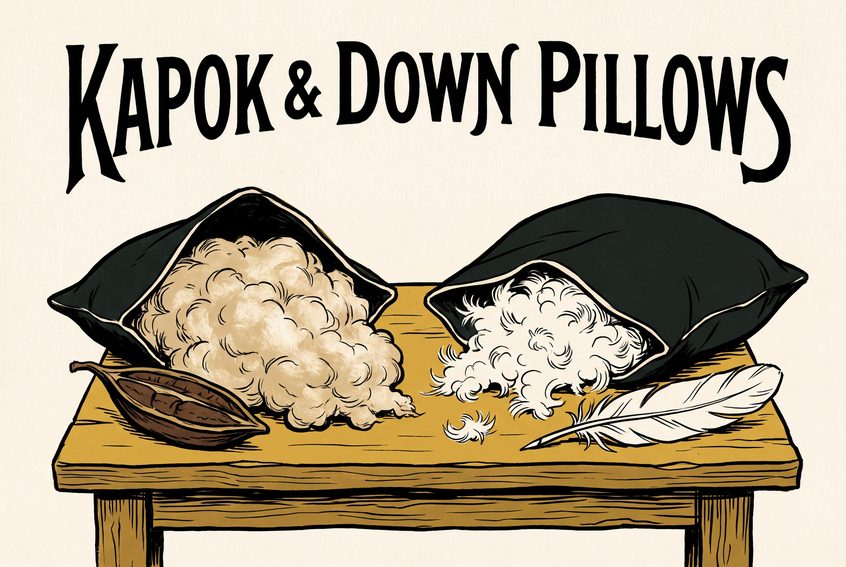
Basis: our judgement, from the constructions sellers publish, not a maker's claim. The first night is the softest a kapok pillow will ever be. A fortnight later you will find your pillow noticeably denser. The fibres have started to pack together. Polyester recovers faster than kapok when new and flattens for good sooner. Down recovers best of all, and it asks for daily shaking in return. A closer look at the two soft fills sits in our guide to how kapok and down behave differently in a pillow.
What happens to the fibre over the first few weeks?
The hollow tubes pack together under a head, then slowly crush and break, so a kapok pillow grows firmer and lower as the weeks go by.
The change starts within days. Under the steady weight of your head, the smooth tubes slide against one another and settle into a denser mass. The pillow becomes a block you push into shape rather than a spring that pushes back. One retailer says plainly that kapok loses resilience relatively quickly (Downpillow). Another warns that the fill may compress slightly over time (Sachi Organics).
Over months, the fibre itself changes. In a laboratory study, pressure crushed hollow kapok fibres partly or totally into flat, thin ribbons emptied of air (Oriental Journal of Chemistry). A resting head presses far less than that test did, so read it as the direction of travel. A kit maker describes this change from the bed. Its fibres break into smaller pieces over time until the pillow shows its true firmness (DIY Natural Bedding).
None of this is a defect. If you shake the pillow daily, the packed fibres pull apart and much of the height comes back. The two-minute routine is set out in our guide to why a kapok pillow clumps, and how to fluff it back.
How much kapok do sellers put in one pillow?
Sellers who print a fill weight disagree by about double, so two kapok pillows of one size can stand at very different heights.
The weight of fibre inside tells you how tall and how firm your pillow will feel, because kapok is too light for the size to tell you much. Weight is the number to look for. In the United States, one maker lists 1.5 lb of kapok in its soft standard pillow and 2 lb in its medium, with firmer pillows heavier again (Carolina Morning on Etsy). A pillow kit specifies 3 lb of fill (DIY Natural Bedding), and one all-kapok listing states 1.5 pounds (Organic Choice on Amazon).
European sellers publish weights by case size, which gives a second set of figures (Weids).
| Case size | Published fill weight | Where it comes from |
|---|---|---|
| US standard, soft to medium | 1.5 to 2 lb, by firmness | Carolina Morning on Etsy |
| US standard, pillow kit | 3 lb | DIY Natural Bedding |
| 40x80 cm | 800 g | Weids |
| 50x70 cm | 850 g | Weids |
| 60x70 cm | 1050 g | Weids |
More fibre in one case means a taller, denser pillow under your head. When a maker sells soft, medium and firm versions of one size, the kapok does not change. Only the amount packed in does. Taking fibre out is messier than it sounds. Loose kapok drifts everywhere once it leaves the case, so you will do better working in small handfuls.
What pillow height does neck research point to?
Research links pillow height to neck angle and pressure under the skull, and the fill material does not appear in those results at all.
Height carries the clearest research base of any pillow variable. Raising a pillow raises the pressure under the skull and opens the angle of the cervical spine, and both effects were recorded across a set of fixed heights (PeerJ). What decides the result is height, body size and the surface underneath.
| Question | What the research reports | What it means for kapok |
|---|---|---|
| Closest-to-standing neck curve on the side | 9.74 to 11.76 cm, scaled to shoulder width | Start high, then remove fibre in small handfuls |
| Comfort ratings | Only weakly linked to height | One night says little |
| Going too high | Cranial pressure rose on the tallest pillow tested | Take fibre out before adding more |
| One correct number | None established for back or side sleeping | A zip matters more than a firmness label |
Sources for rows one and two: Med Biol Eng Comput. Row three: PeerJ. Row four: a systematic review reached no firm conclusion on optimal height for either position (Ergonomic Consideration in Pillow Height). The right-hand column is our judgement.
Kapok has one real advantage here, because the fibre comes out by the handful. You can move along the height range without buying a second pillow. A sealed kapok pillow is a fixed guess about your shoulders. A zipped one lets you correct that guess after a week of sleeping on it.
What changes when a side sleeper lies on kapok?
On the side, the pillow must fill the gap from ear to shoulder all night, which asks more of a soft, settling fibre than any other position.
When you lie on one side, your shoulder holds your body off the mattress and your head has to bridge the gap. Sleep Foundation guidance says most side sleepers need at least 4 inches of height, and broad shoulders need more (Sleep Foundation). A soft mattress lets the shoulder sink and shrinks the gap. A firm one keeps it high.
Pure kapok gives way under that steady load. If you sleep on your side, you will usually end up with more fibre in the case. Sellers often solve the problem with latex instead. The one blend in our count that stated its ratio was mostly latex by its own figures. At that ratio, you are sleeping on latex with some kapok in it.
Our count: on 23 September 2026 we read 7 seller pages for kapok bed pillows sold to US buyers and sorted each by what it says the fill is.
| What the page says the fill is | Pages |
|---|---|
| All kapok | 3 |
| Kapok and latex, ratio stated | 1 |
| Kapok and latex, no ratio stated | 3 |
Three of the seven sold a pillow made for side sleepers, and all three blended kapok with latex. The all-kapok pages sold plain rectangles for any position. If a page sells a pillow for side sleeping, expect latex inside unless it says otherwise.
What does the word organic cover on a kapok pillow?
On a kapok pillow, organic can describe the harvest, the cotton case or both, and the two rest on separate rulebooks with separate tests.
Kapok is gathered from pods on standing trees, so the federal rule that applies to the fibre is the wild-crop standard. It requires a harvest area with no prohibited substance applied for three years, and harvesting that sustains the stand (federal wild-crop rule). That is a rule about land and harvest, and it says nothing about the case.
Textile labels follow other rules. USDA guidance lets a label call a specific fibre organic when every instance of it is certified, and keeps the USDA seal for finished products certified as a whole (USDA AMS).
| Claim on the label | What it covers | What it leaves out |
|---|---|---|
| Organic kapok | A harvest area free of prohibited substances for three years | How the fibre is cleaned and graded |
| Organic cotton case | The shell fabric, when the case carries its own certificate | The fibre inside the shell |
| USDA organic seal | A finished product certified to USDA rules | Products where only one fibre is certified |
| Hypoallergenic | Nothing checkable; it is a description | Dust mites, which settle in any bedding |
Basis: the rules named above; the last row is our judgement. A certificate that names the cover says nothing about the fill. The fibre's own record with allergies is covered in our guide to whether you can be allergic to a kapok pillow.
How does a kapok pillow age, and what does topping up involve?
Kapok settles rather than failing suddenly, so a handful of new fibre through the zip is the repair, and the cotton shell usually wears out first.
The pillow you shaped in spring is thinner by autumn. That is normal. Sellers say so themselves. One describes settling after delivery that is answered by adding more fibre through the zip (Kapok Shop). Loose fibre is sold for exactly this job. One seller packs refills in bags of about 1.4 oz (40 g), a sensible step for small changes (Cocoon). A kit maker ships at least a pound of extra fibre with each kit for this reason (DIY Natural Bedding).
Speed depends on the sleeper. A light back sleeper may go years on one fill, while a heavy side sleeper can flatten a soft pillow in a season. Our judgement, from seller statements rather than any test here, is that the cotton shell goes before the fibre does. Seams wear and cotton yellows. If you have kept the fibre dry, you can move it into a new shell.
Your fibre is finished when it turns gritty, grey or dusty after two top-ups. Then a fresh bag replaces it. Water shortens all of this, which is why the fibre stays out of the washer; our guide to what water does to kapok explains the reason.
Common questions
Why does a new kapok pillow feel so different a month later?
The hollow fibres pack together under the weight of your head. They stay packed until they are shaken apart. A new pillow is at its loosest and softest, and after a few weeks the fibre sits denser and lower. A daily fluff brings back much of the lost height.
Does a kapok pillow sleep warm?
Kapok sleeps warmer than a loosely filled down pillow and cooler than solid foam. The hollow fibre holds air, and held air keeps heat near the face. How tightly you pack the case decides most of it. A denser pillow holds more warmth.
Is kapok the same thing as silk cotton?
Yes. Silk cotton, java cotton and kapok all name the floss from Ceiba pentandra seed pods, and listings mix the names freely. Check whether the fill is pure kapok or blended with latex or polyester, because a blend changes both the feel and the care rules.
Is kapok a fire risk in a bed pillow?
Raw kapok catches fire easily and burns out quickly, according to a flammability test of untreated kapok sheet (Polymers study). The federal mattress ignition rule excludes pillows (federal mattress flammability rule). Keep candles off the nightstand and refill the pillow well away from a stove.
What size is a standard kapok pillow in the United States?
A standard case fits a pillow of 20 by 26 inches. Queen and king pillows keep that width but run longer. A pillow that overhangs its case slumps at the ends and sleeps lower than its fibre weight suggests, so the case and the pillow should match.
Can you add more kapok later?
Yes, through the zip, and most owners do. Sellers of zipped pillows say the fibre settles and tell buyers to add more as needed (Kapok Shop). A small refill bag kept in a dry cupboard makes the fix a two-minute job.
The kapok check works through answers like these to a specification: a full kapok fill for side sleepers, a lighter kapok fill for back and stomach sleepers or coming from foam: a fuller kapok pillow, and what the first week feels like.
Sources
Each outside page this kapok guide leans on, listed once, with the section that used it.
- IJDNE (iieta.org), used in “What is inside a kapok pillow?”.
- Layla (laylasleep.com), used in “What is inside a kapok pillow?”.
- Downpillow (downpillow.com), used in “What happens to the fibre over the first few weeks?”.
- Sachi Organics (sachiorganics.com), used in “What happens to the fibre over the first few weeks?”.
- Oriental Journal of Chemistry (orientjchem.org), used in “What happens to the fibre over the first few weeks?”.
- DIY Natural Bedding (diynaturalbedding.com), used in “What happens to the fibre over the first few weeks?”; “How much kapok do sellers put in one pillow?”; “How does a kapok pillow age, and what does topping up involve?”.
- Carolina Morning on Etsy (etsy.com), used in “How much kapok do sellers put in one pillow?”.
- Organic Choice on Amazon (amazon.com), used in “How much kapok do sellers put in one pillow?”.
- Weids (weidslivingandsleeping.com), used in “How much kapok do sellers put in one pillow?”.
- PeerJ (ncbi.nlm.nih.gov), used in “What pillow height does neck research point to?”.
- Med Biol Eng Comput (link.springer.com), used in “What pillow height does neck research point to?”.
- Ergonomic Consideration in Pillow Height (ncbi.nlm.nih.gov), used in “What pillow height does neck research point to?”.
- Sleep Foundation (sleepfoundation.org), used in “What changes when a side sleeper lies on kapok?”.
- federal wild-crop rule (ecfr.gov), used in “What does the word organic cover on a kapok pillow?”.
- USDA AMS (ams.usda.gov), used in “What does the word organic cover on a kapok pillow?”.
- Kapok Shop (kapok.com.au), used in “How does a kapok pillow age, and what does topping up involve?”; “Common questions”.
- Cocoon (cocoon-company.com), used in “How does a kapok pillow age, and what does topping up involve?”.
- Polymers study (pmc.ncbi.nlm.nih.gov), used in “Common questions”.
- federal mattress flammability rule (ecfr.gov), used in “Common questions”.